

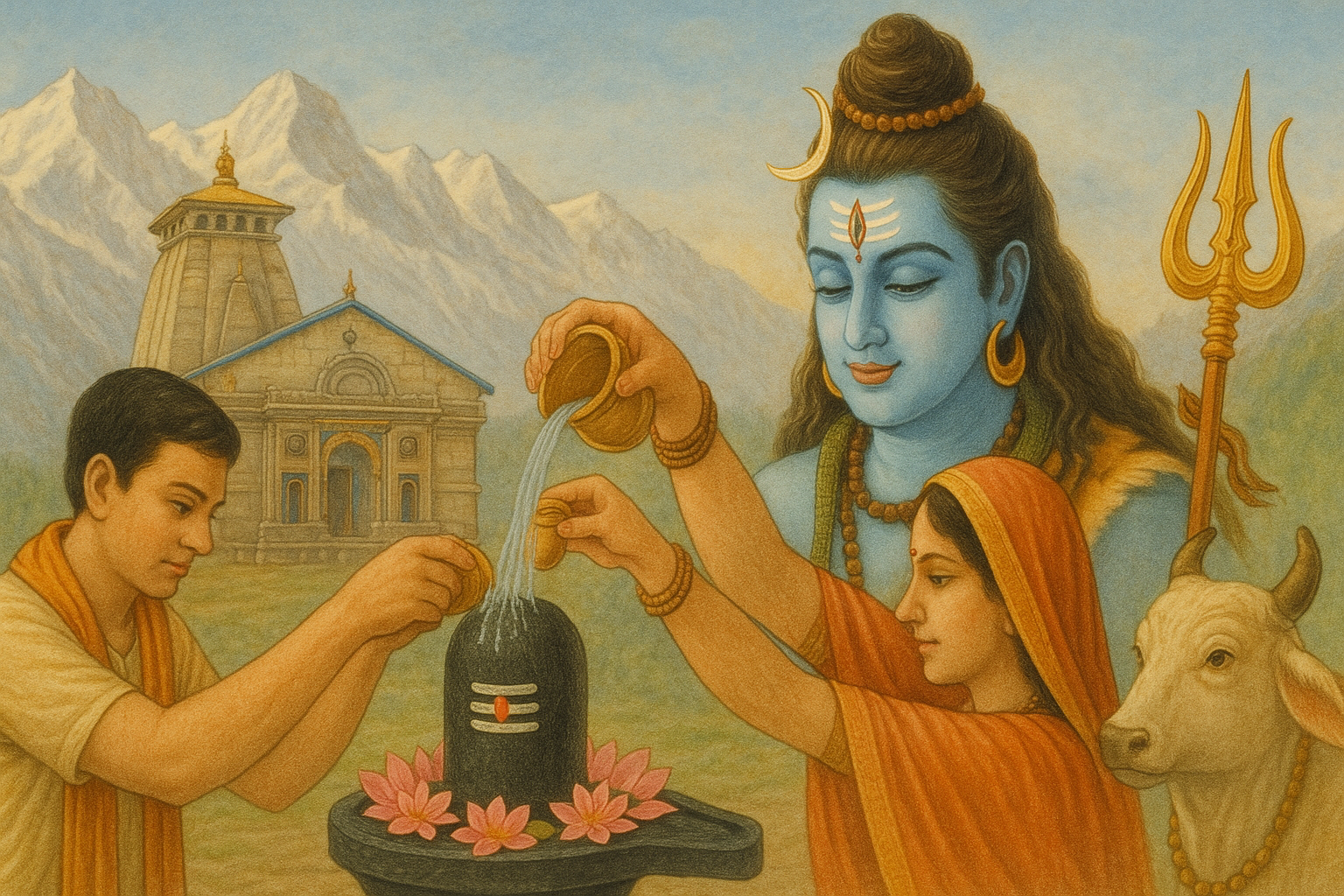
Shravan does not announce itself with fanfare.
It arrives quietly — like the moment between two breaths.
Across temples and homes, across cities and rivers, a deeper rhythm begins to stir. One that doesn’t belong to the clock, but to the soul.
In this sacred month, time bends toward devotion.
Mondays carry meaning. Tuesdays hold tenderness. And in between, something shifts — in silence, in intention, in you.
Whether you’re following the North Indian calendar or South Indian tradition, Shravan is a shared experience — rooted in reverence, shaped by ritual, and elevated through self-awareness.
But it isn’t about what you do.
It’s about what you become.
At Dharmdarshnam, we walk through Shravan not as observers, but as participants. This is more than a blog. It’s a reflection of a journey — from Shiva to Self.
Shravan Somwars: The Four Mondays of Transformation
Each Monday in Shravan is a portal into silence, devotion, and dharmic reflection. As per tradition, devotees fast on Mondays — some with water only, others with a single meal after sunset. They visit temples, chant “Om Namah Shivaya,” and offer water, milk, and Bilva leaves to Shiva Lingams.
But more than these outer rituals, it’s the inner shift that matters most. Each Shravan Somwar is a spiritual checkpoint:
- First Monday — Letting Go: Surrendering attachments and ego.
- Second Monday — Devotion: Deepening connection with Shiva through bhakti and mantra.
- Third Monday — Service: Expressing Dharma through compassionate action.
- Fourth Monday — Realization: Awakening to the truth that Shiva is not outside, but within.
Whether you’re walking barefoot to the temple or sitting in quiet meditation, even your attire can become part of this sacred expression.
Beyond the Mondays: Sacred Observances of Shravan
Shravan is not just about Mondays. It’s a sacred calendar of energies — each day holding cosmic meaning.
On July 23, 2025, we celebrate Shravan Shivratri — a powerful night for shiva sadhana Devotees stay awake through the night, chanting and meditating, inviting deep inner stillness. According to yogic science, this is a night when spiritual energies peak, making it ideal for transformation.
Then comes Nag Panchami on July 29. On this day, snakes — symbols of energy and fearlessness — are honored as Naga Devatas. They represent Kundalini Shakti, the coiled energy at the base of the spine. Farmers pray for rain and fertility, while spiritual seekers bow to the energy of regeneration and protection.
Shravan isn’t just ritual. It’s resonance. It’s when ancient vibrations meet your modern choices. Every act — whether offering milk, chanting a mantra, or wearing intention — becomes a form of sacred participation.
Tuesdays of Gauri Vrat: The Divine Feminine in Devotion
In the background of Shiva’s silence is the voice of Shakti. During Shravan, Tuesdays are dedicated to Maa Gauri — the benevolent form of Parvati. In North India, Gauri Vrats fall on July 15, 22, 29, and August 5. In the South, they align with July 29, August 5, 12, and 19.
Women observe fasts and prayers, seeking strength, grace, and family harmony. More than just a custom, this is an act of aligning with the feminine principle of Dharma — patience, inner strength, and unwavering love.
It is said that Parvati meditated for eons to unite with Shiva. And her tapasya wasn’t passive. It was power in stillness. At Dharmdarshnam, we draw inspiration from her — creating garments that reflect this union of devotion and determination.
The Journey from Shiva to Self: A Dharmic Interpretation
There is no single image of Shiva. No form, no name, no scripture can contain him. He is the formless — the stillness behind thought, the silence behind sound. And yet, he is within all of us.
This is what Shravan teaches us. That through fasting, mantra, seva, and self-inquiry, we come closer to not a god — but a state of being.
To walk the path of Dharma is to walk from Shiva to Self. From searching to remembering. From external ritual to internal realization.
And every action on this path — even how we dress — becomes part of our sadhana.
Wearing Your Dharma: Expression Through Conscious Clothing
In a world of fast trends and fading meaning, what you wear can become your statement of alignment. At Dharmdarshnam, our designs are inspired by sacred geometry, ancient mantras, and dharmic icons — not as decoration, but as intention.
A printed “Om Namah Shivaya” isn’t just art. It’s a vibration. A reminder. A wearable invocation.
This Shravan, wear your Dharma. Let your clothing reflect your reverence. Let your choices reflect your consciousness.
Conclusion: Shravan Is Not a Season. It’s a State of Being.
As the final Monday passes and the last diya flickers out, Shravan leaves behind something more than memory — it leaves behind meaning.
It teaches us that time can be sacred. That silence can be strength. That Dharma is not an idea — it is a lived experience.
From Shiva to Self is not a journey of distance, but of depth. It happens quietly. Through mantra. Through intention. Through presence.
And sometimes, through the sacred fabric you wear.
🕉️ May this Shravan be your return. May you walk with Dharma, wrapped in devotion, and held by the rhythm of the sacred.